By Tom Ducatte
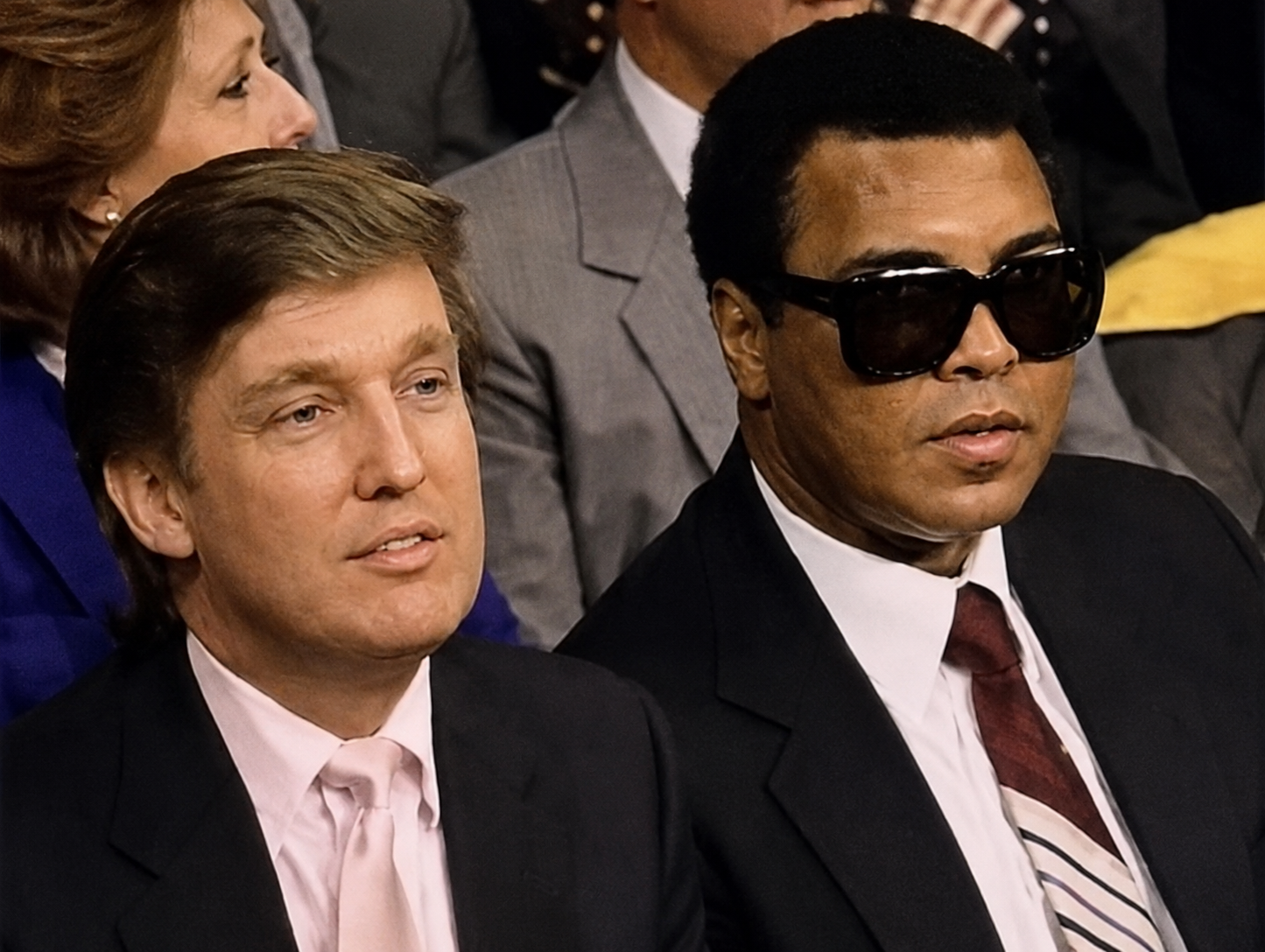
Donald Trump and Muhammad Ali seem to belong to two disparate worlds: one a heavyweight champion and cultural icon, the other a businessman-turned-politician who rose to the presidency. Yet the parallels between the two men are worthy of attention. Both demonstrated a commitment to genuineness, a craving for validation, and a willingness to confront powerful institutions. Much like the song “Still the Same” by Bob Seger and the Silver Bullet Band, both men can be viewed as titans who never changed at their core despite public backlash when each took the stage in different eras.
Show me your friends and the people you admire, and I’ll show you where you’re headed in life. Ali admired championship boxers Joe Louis, Sugar Ray Leonard, and Jack Johnson. Johnson, the heavyweight champion from 1908 to 1915, challenged Jim Crow laws and racial inequality as a Black man.
The youngster from the Bluegrass State looked up to Black leaders such as Martin Luther King Jr., Malcolm X, and Elijah Muhammad. Trump was friends with WWE wrestling promoter Vince McMahon. McMahon promoted Ali’s fight with Antonio Inoki in Tokyo, Japan, in 1976. Gorgeous George, a professional wrestler in the 1940s and 1950s, transformed wrestling from a relatively dry sport into an over-the-top theatrical spectacle built around villainous flamboyance. George was a considerable influence on the young Cassius Clay. The 19-year-old Clay went backstage when George wrestled in Las Vegas in 1961. George’s act included predicting outcomes, mocking opponents, bragging, and turning matches into entertainment. Angelo Dundee once said, “Ali was never a big talker until he saw Gorgeous George perform in person.”
Trump’s idol was his father, Fred, a successful New York real estate developer. Colonel Theodore Dobias, who served in World War II, was a major influence in straightening out the disruptive Trump after he arrived at the New York Military Academy, located 60 miles north of New York City. Dobias was Trump’s baseball coach and drill instructor. Trump also emulated Conrad Hilton, who achieved great success in the hospitality industry. Trump admired William McKinley, the 25th president, who used tariffs and believed in economic nationalism. McKinley stayed at the Hotel Champlain during the summers of 1897 and 1899, using the facility as his “Summer White House.” The hotel was located on Lake Champlain in Plattsburgh, New York. The person who truly caught Trump’s attention was Roy Cohn, his legal counsel for 13 years. Cohn shaped Trump’s aggressive approach to business, media warfare, and politics. The high-powered lawyer taught the future president that contrition is a sign of weakness.
Muhammad Ali and Donald Trump were friends for more than 30 years, with Ali attending Trump’s marriage to his current wife, Melania, in 2005. Ali was upset in 2015 when Trump, during his presidential campaign, proposed a temporary ban on Muslims entering the country.
For students of astrology, Trump was a Gemini and Ali a Capricorn. There are 12 rising signs in astrology, corresponding to the 12 signs of the zodiac. Trump and Ali shared the rising sign of Leo, often associated with charisma, showmanship, and a larger-than-life presence. That’s a bull’s-eye match if there ever was one.
It might be fun to compare the two men across 15 different aspects of their lives. The number 15 symbolizes the rounds of a heavyweight title fight during Ali’s prime boxing years. The first 14 rounds present a real-life comparison. The fifteenth round allows for the use of imagination to explore how this fight might end. This is primarily a comparison of two people, although athleticism will also be considered. I’ll score the fight impartially over 15 rounds. Score along if you wish.
“Fasten Your Mouthguards Gentlemen, Let’s Get Ready to Throw Verbal Haymakers!”
Tale of the Tape at age 25
Muhammad Ali
Height/Weight – 6’3″, 220 pounds
Reach – 78″
W-L 56-5-2 (Heavyweight Champion 3 times)
Hometown – Louisville, Kentucky
Nickname – “Louisville Lip”
Trash talk capacity – Never left a thought unexpressed
Donald Trump
Height/Weight – 6’3″, 230 pounds
Reach – 75″
W-L 10-2 (Business, Media and Public Battles)
Nickname – “The Donald”
Trash talk capacity – Favorite word is loquacious
Round 1 – Who Craved Attention More?
Ali was as much a performer outside the ring as he was inside it. His rhymes, predictions, and theatrical press appearances captivated audiences worldwide. Before his fight with Joe Frazier, he famously declared: “It will be a killa and a chilla and a thrilla when I get the gorilla in Manilla.”
Trump, in a different arena, mastered media attention through bold statements such as “You’re fired” on his television show, “The Apprentice.” At rallies, he maintained a commanding presence that kept him in the spotlight. Neither man avoided attention; both capitalized on it to solidify their influence.
Round 1: Trump
Round 2 – Who Had More Charisma?
I saw Muhammad Ali in 1976 while he trained for his third fight against Ken Norton at an airport hangar in Show Low, Arizona. He possessed an aura that day I’ll never forget, making it my greatest sports memory. Ali’s trainer, Bundini Brown, got us into the closed training session after a two-and-a-half hour drive from Northern Arizona University.
I saw Trump from a non-partisan perspective in 2015 when he appeared at a presidential campaign rally in Plattsburgh, New York. Trump’s entrance on a stage is usually the gestures of clapping and thumbs-up and pointing at individuals in the crowd. His personality and energy filled the arena much as Ali’s did, but he did not possess the same magnetic presence as “The Champ.”
Round 2: Ali
Round 3 – Who Had A Better Diet?
Ali’s go-to meal was baked chicken, macaroni and cheese, green peas and spinach. He enjoyed bean pie, a custard-based dessert made with navy beans and cinnamon. Comedian Dick Gregory, a lifetime friend, often brought healthy concoctions for Ali to drink. Ali would tell Gregory: “How are you gonna help me when I won the Heavyweight Championship of the world my way?” Over time, however, Ali became more open to Gregory’s nutritional advice.
Ba-da-ba-ba-ba. Trump’s aides said he stocked his private plane with McDonald’s fast food, Kentucky Fried Chicken, pizza and Diet Coke. Trump believed major chains maintained a higher standard of cleanliness than unknown restaurants. When eating pizza, he reportedly preferred toppings and skipped the crust. Trump’s fondness for Big Macs is well known, though there is no truth to the rumor that Melania Trump once heard him mumbling in his sleep: “Two all-beef patties. No, no fake news. It’s two patties, not one. Special sauce, lettuce, cheese, pickles, onions on a sesame-seed bun.” Mr President, get on the treadmill.
Round 3: Ali
Round 4 – Who Had The Better Braggadocio?
Their personalities were marked by bluster and bravado. If the two men ever engaged in a “brag-off,” it might have sounded something like this:
Ali: “I predicted the rounds, made champions fall. I’m a bad man. I am the greatest.” Ali elevated bragging into poetry. “What do you say, Mr President?”
Trump: “That’s nothing, Champ. Frankly, nobody’s ever seen anything like what we’ve done. We had the greatest economy in the world. Can you imagine world leaders calling me, ‘sir’?”
In both cases, this brash confidence drew both admiration and criticism, but it undeniably contributed to their larger-than-life personas.
Both of them were boomerang conversationalists. The conversation usually came back to them.
Round 4: Even
Round 5 – Who Overcame Being “Finished”?
Ali lost three and a half years of his career from ages of 25 to 28, the prime years physically of his life. Many thought he would never regain his title. Yet Ali defeated George Foreman in 1974 and Leon Spinks in 1978 to reclaim his heavyweight championship, adding to the title he first won by beating Liston in 1964.
Trump’s comeback came in 2024 when he defeated Kamala Harris and joined Grover Cleveland as the only presidents to serve nonconsecutive terms.
Round 5: Even
Round 6 – Who Defied Authority More?
Both men’s willingness to challenge the establishment deepens the comparison.
Along with Ali’s anti-war stance –”I ain’t got no quarrel with them [sic] Viet Cong”– remains one of the defining moments of his life. He also challenged the system of sports establishment during an era when Black athletes were often expected to be quiet, humble and grateful. In addition he pushed back against segments of the white-dominated sports media that resisted using his adopted Muslim name.
Trump disputed the 2020 election results and spent years engaged in legal, political and impeachment battles. While the circumstances differed dramatically, both men experienced periods in which conflict with larger systems interrupted their primary pursuits.
Round 6: Ali
Round 7 – Who Sparred More With The Press?
Their relationships with the press also mirror one another.
Ali often sparred verbally with journalists, using humor and wit to control the narrative. As he once told Howard Cosell: “Howard, you’re a nice man, but you talk too much.”
Trump’s sparring was more combative. He frequently engaged in confrontational exchanges with reporters and news organizations while challenging their coverage. He often says, “Fake news, they’re very dishonest people.”
Trump
Round 8 – Who Gave Better Nicknames To Opponents?
Ali’s boxing opponents and Trump’s political antagonists were frequently on the receiving end of ridicule.
Ali gave opponents colorful labels. He referred to Earnie Shavers as “The Acorn” and George Foreman as “The Mummy.” Less famously he labeled Joe Frazier “The Gorilla” and an “Uncle Tom.” Ali’s trash talk was often promotional, but it had a tactical purpose: provoking opponents into emotional reactions that could lead to opponent’s mistakes in the ring.
Trump famously coined labels such as “Low Energy Jeb” for Jeb Bush and for Elizabeth Warren he bestowed her the name “Pocahontas.” His mudslinging had a big kid bully on the playground spirit. Trump calls you what he wants to, not what your mom and dad agreed upon.
Round 8: Trump
Round 9 – Who Was The Better Dancer?
Even their celebratory movements reflect a shared flair for performance.
The one and only “Ali Shuffle” became an iconic symbol of Ali’s athleticism and charisma.
Trump’s dance to “YMCA” became a recognizable feature of his rallies. At times, it resembled a happy parking lot attendant at a county fair moving to the music over the loud speakers while entertaining arriving cars. The gestures were simple, but it highlighted his ability to connect with audiences. Most of us can perform the “The Trump Invisible Elliptical Dance,” but few can replicate the skillful footwork and showmanship of the “Ali Shuffle.”
Round 9: Ali
Round 10 – Who Had The Better Upset(s)?
Perhaps the most intriguing parallel lies in how each man toppled a giant in his respective field.
On February 25, 1964, a 22-year-old Cassius Clay defeated Sonny Liston and proclaimed that he had “shook up the world.” A decade later, he knocked out George Foreman in the “Rumble in the Jungle” in Zaire.
On November 8, 2016, Trump stunned political observers by defeating Hillary Clinton and reshaping the political landscape. After claiming victory, Trump the night of the win turned from a combative showman into a more traditional statesmanlike figure – at least for one night!
Round 10: Even
Round 11 – Who Impacted The World More?
Ali’s image transcended boxing. He became associated with social issues, civil rights and anti-war movements. People in Asia, Africa, Europe, the Middle East and the Americas knew who Ali was even if they weren’t familiar with boxing.
Presidents can obviously change the outcome of wars, laws, international relationships and economies. Ali uplifted and awakened people, while Trump’s impact was more institutional.
Round 11: Trump
Round 12 – Who Faced The Greater Mortal Threats?
A sobering category.
Ali endured hostility throughout his career because of his race, religion, anti-war stance and national prominence. After changing his name from Cassius Clay and joining the Nation of Islam under leaders Elijah Muhammad and Malcom X, he faced significant backlash. FBI files documented death threats directed at Ali.
Trump survived ab assassination attempt in Butler, PA, in July of 2024 that resulted in an injury. Two months later, another apparent attempt was made on his life at his Trump International Golf Club course in West Palm Beach, Florida.
Round 12: Trump
Round 13 – Who Could Take a Punch Better?
Ali literally absorbed punches from Joe Frazier, Ernie Shavers and George Foreman. Both in and out of the ring, he weathered tremendous storms. Unfortunately, years of taking punches contributed to the Parkinson’s disease that affected him later in life.
Trump’s chin, figuratively speaking, could take a blow as well. Early in his career, he endured business crises, including the bankruptcies of several Atlantic City casinos. Later, as president, he faced impeachments, legal challenges and relentless political attacks, yet he never disappeared from public view.
Both men, when knocked down, got back up and continued fighting through adversity.
Round 13: Even
Round 14 – Who Had The Better Signature Look?
When Ali entered the ring, it was part of the show. He usually wore plain white trunks with two black stripes down the sides, a simple white robe and, on occasion, tassels on the back of his boxing boots. The tassels seemed to reinforce the spirit of his famous slogan: “Float Like a butterfly, Sting Like a bee.”
Trump’s signature look centered on his distinctive hair, which over time turned from blond to white, along with his trademark tan. His usual attire consists of a dark business suit, a white dress shirt and a long red tie that reaches to his belt line. When he isn’t in his suit he is frequently seen in golf attire. Trump’s branding was rigid while Ali’s was always dynamic. “Rumble, young man, rumble!”
Round 14: Ali
Round – 15 Who Was A Better Athlete?
The fight is close and there’s a good chance it’s coming down to this round.
Trump was a multisport athlete, but not in Ali’s league athletically. At New York Military Academy, he was a very good first baseman and pitcher who also played football and soccer. He participated in intramural basketball, bowling and softball as well. A childhood classmate, Chrisman Scherf, recalled Trump. “Trumpet” – his nickname at the time – was always the last person standing in playground dodge ball games. Trump might say, “Nobody dodged like I dodged. Frankly, people at the Kew-Forest Elementary School in Queens still talk about it.”
Ali, meanwhile, is considered by many the greatest heavyweight boxer of all time. Trump was four years Ali’s junior. Trump below the neck somewhat resembled Chuck Wepner, the “Bayonne Bleeder.” If he climbed into the ring with Ali, the 42-1 odds Buster Douglas faced against Mike Tyson would have looked modest by comparison.
The Final Round – Which Outcome Is More Likely?
Trump KOs Ali
Trump, like Chuck Wepner, made it into the 15th round. Lo and behold, using his military academy training, “Trumpet” pulled off a sneak attack by employing an ambush infiltration tactic against Ali.
The Queens native slowly lay face down on the canvas for 30 seconds before the bell, pretending to search for his mouthpiece. “Ambush” Donald, all the while, surreptitiously crawled and slinked toward Ali’s corner. Fans screamed for Ali to watch out, but Madison Square Garden was too loud for anyone in Ali’s corner to hear.
Trump’s timing was perfect. When the bell rang, Dundee yelled, “Champ, duck!” But it was too late. Trump sprang to his feet and landed a punch Ali never saw coming. Ali was in “Tweety Bird Heaven.”
Trump later remarked:
“He ran right into my fist. He was moving way too fast. Angelo Dundee and Bundini did such a poor job getting him ready in his corner. Some people are saying it was the greatest knockout in sports history—maybe ever! Ali fought bravely, but everyone knows my punches are massive. Massive. In fact, the referee came up to me afterward with tears in his eyes. He said, ‘Thank you, sir, for saving the sport of boxing and the country.’ A beautiful moment. Just beautiful.”
Ali KOs Trump
“Twinkle, Twinkle, Trump Sees Stars.”
After stepping into the ring with Ali, Trump was knocked out just eight seconds into the fight while wearing gold headgear. His response afterward was:
“It was a very dishonorable punch. Very sudden. Way too fast. Many members of the press are saying I looked tremendous on the canvas. Tremendous. Very photogenic. Maybe even better than Liston.”
Ali said, “Trump was sleeping so hard I wanted to tuck him in and say, ‘Nighty-night.'”
By the time “The Donald” blinked, “The Louisville Lip” had already introduced Trump to a jab clocked at 0.04 seconds.
Let’s get serious here, boys and girls.
Ali: 6 rounds
Trump: 5 rounds
Even: 4 rounds
Winner: Ali
For Muhammad Ali, it would take time for him to become accepted because he challenged entrenched ideas about war, race, faith, and patriotism. More than thirty years later, however, he is a beloved figure in American history. Trump emerged as a disruptor of political norms at a time when many Americans were looking for someone to fight for traditional America. History, as always, will render its verdict on the 47th President in due time.
A 15-round comparison of the two men leads to an inescapable conclusion: Ali and Trump inhabited two very different professional worlds, yet they shared similar temperaments and were cut from the same cloth.
Bob Seger’s song “Still the Same” was written about the gamblers and hustlers he met in Las Vegas. Ali and Trump were, in a figurative sense, high-stakes gamblers who repeatedly doubled down when others expected them to fold. Both were masters of the bluff, wagering their legacies through their rebelliousness. As the years pass, it becomes clear that ego-driven figures like football’s Vince Lombardi, technology’s Steve Jobs, and both Ali and Trump did not adapt to the times so much as force the times to adapt to them. They did not reinvent themselves to satisfy critics but instead remained committed to their own operating philosophies without chasing every new trend. Each had his own playbook, and the first words in it were: “Damn the torpedoes, full speed ahead.”
Driven by that merciless conviction, they became unforgettable figures in history.
