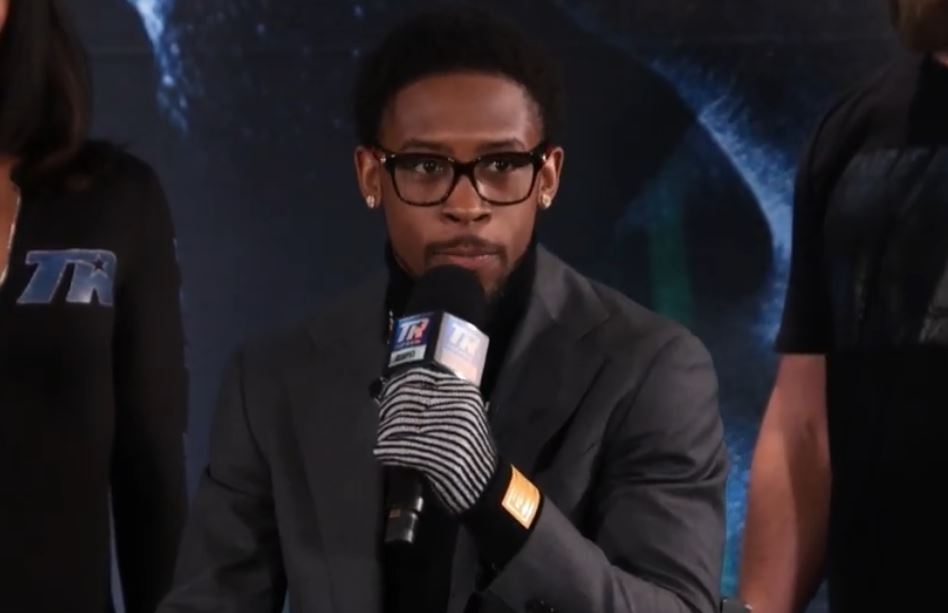
For months, Keyshawn Davis played the role of boxing’s straight shooter. While other young stars tiptoed around each other, ducking mandatory fights and hiding behind vague excuses, Davis positioned himself as the guy who wanted smoke. He called out Devin Haney directly. He needled other fighters on social media for avoiding tough matchups. He built a persona around one simple idea: I’ll fight anybody, and I’m not afraid to say who’s running from me.
That persona is now in tatters.
When the WBO ordered Haney to defend his welterweight title against Davis, his mandatory challenger, and the fight went to a purse bid, Top Rank — Davis’s own promoter — won it with an offer worth $8.55 million. Under the standard 75/25 champion-challenger split, that would have put roughly $2.14 million in Davis’s pocket for a career-defining fight against a fellow unbeaten 27-year-old with a legitimate claim to being one of the best pound-for-pound fighters in the sport. Instead, Davis walked away from it.
Let that sink in. This wasn’t a lowball offer from a rival promoter looking to shortchange him. His own team won the bid. The fight was his to take. And he said no.
The reporting suggests Davis wanted a guaranteed net purse in the neighborhood of $5 million, despite never having earned more than $1 million for a single fight in his career. That’s not a modest ask for a step up in class — that’s a number that reads like a fighter trying to price himself out of a fight he no longer wanted, while leaving himself a talking point about being “underpaid.” Teofimo Lopez, whose own promotional outfit was the only other bidder in the process, put it plainly: once you get all the way to a purse bid and then pull out, that’s a duck move, full stop. You don’t get to talk your way to a mandatory shot and then walk away from the number your own promoter negotiated.
And that’s really what makes this sting. Davis didn’t quietly slide out of the picture the way plenty of fighters do — citing an injury, a scheduling conflict, a soft “not right now.” He spent the lead-up loudly campaigning for this fight, needling Haney and his camp, and generally positioning himself as boxing’s designated truth-teller on the subject of ducking. Bill Haney has already needled him for going quiet on negotiations. Timothy Bradley didn’t hold back either, essentially arguing that Davis hadn’t earned the standing to turn his nose up at a life-changing purse after everything he’d done publicly to get himself into this position. Even Shakur Stevenson, a friend of Davis’s, wasn’t fully buying the money explanation and suggested there’s more to the story.
Here’s the uncomfortable truth for Davis: intent matters less than the pattern. Fighters who call out their peers for avoiding fights are implicitly setting a standard for themselves — if you talk that talk, you’d better walk into the ring when the number’s finally on the table. Davis didn’t just miss that standard. He missed it in the most public way possible, after a WBO order, after a purse bid, after his own promoter delivered a winning number. There’s no ambiguity to hide behind here.
None of this means Davis lacks the talent to be a legitimate threat at 147 pounds. He’s undefeated, heavy-handed, and still just 27. But talent was never really the question. The question was always whether he’d back up the talk. And when the money was finally real and the fight was finally his for the taking, he didn’t.
Fighters get to change their minds about purses. They get to negotiate hard. What they don’t get to do — not credibly, anyway — is spend a year clowning other fighters for ducking and then duck the biggest opportunity of their own career. Davis wanted to be seen as the guy who separates himself from a “softer generation” of boxers unwilling to take risks. Instead, he handed his critics the exact receipt they needed to make the opposite case.
Talk gets you attention in boxing. Fights get you a legacy. Right now, Keyshawn Davis has plenty of the first and none of the second — and he only has himself to blame for the gap.
