The Third Man in the Boxing Ring Can Be a Gangster, but He Can’t Be a Crook
Three men always enter the squared circle, but only two are supposed to have a side. Even so, consistent “errors” in judgment reveal favoritism in more boxing matches than we ought to tolerate.
Of course, boxing is not the only sport with officiating controversies, but it is one of the few where a single moment or a referee’s bad decision can end a competitor’s career—remember Prichard Colón (descanse en paz).
Even outside of worst-case scenarios, boxing is one of the few sports where a single loss can set a competitor back years from their goal and scratch a zero off the end of their next paycheck, taking food off their children’s plates in either case.
This is why there should be no tolerance for favoritism in the sport, and it should be the referees who suffer when their mistakes go beyond a momentary lapse in judgment.
As I sit here tapping keys, the month of October isn’t even halfway finished, and we already have at least two prime examples of referees who—at least to my eyes—had clear agendas. The first comes from jolly old England—a place where (once again, at least to my eyes and ears) the officiating, judging, and commentating may as well be done by the hometown favorite’s mum, da, nan, and a handpicked squad of his or her favorite uncles. Think of Ricky Hatton (rest in peace) getting stunned by a body shot from Juan Lazcano, only to have the referee stop the action not once, but twice. The second time was at Ricky’s request to tie his shoes—all while the British commentating crew completely ignored the obvious trouble their man was in.
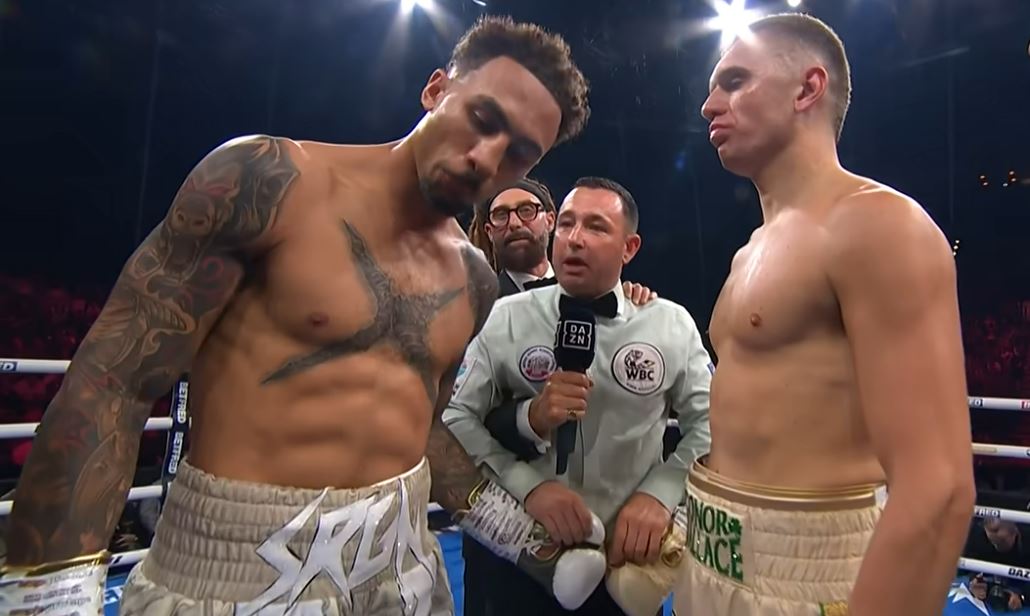
The night of October 3 saw rising British star Ben Whittaker headline against the unheralded Connor Wallace of Irish-Australian roots. The fight reminded me of Moses Itauma’s effort against Filip Hrgović, which took place weeks prior. Both Itauma and Whittaker came out smoking—landing big shots at will and dazzling the crowd. Yet both men faded late. Itauma was stopped as the man best qualified to play Lurch in an Addams Family reboot never broke and never quit under the weight of the up-and-comer’s assault. Whittaker also faded late and got rocked. However, he had something on his side that could not save Itauma: a guardian angel named Kieran McCann in the ring with him.
Despite Whittaker being rocked and clearly dropped, the referee managed to “miss” multiple knockdowns. He also said nothing about the headbutts, excessive clinching, or rugby tackles Whittaker resorted to while hurt. To be clear, at minimum one knockdown should have been called. Barring that, the referee also had the opportunity to take away a point for excessive holding, another for what appeared to be intentional headbutts, and an absolute mandate to deduct a point for tackling. And yet the referee did nothing apart from separating the fighters from clinches with no urgency and allowing Whittaker to take his sweet time getting ready to restart the action after tackling Wallace. The debacle was shameful, and about what I have come to expect from officiating in England. With the UK-based Matchroom and Queensberry having become two of the most prominent promotional enterprises in the game, this problem is only going to increase in relevance.
Now, to be fair to the UK and its rich boxing culture, England is not the only place in the world with its issues. Good luck getting a fair shake in Germany, and let’s not pretend the good ol’ US of A is much better. I mean, Floyd Mayweather Jr. had his own in-house referee—Kenny Bayless—who was about as courteous to Mayweather’s style and as anti-pressure-fighter as it gets. You can also think back to Tony Weeks stopping the fight between PBC industry plant Rolando “Rolly” Romero and Venezuela’s Ismael Barroso. The Venezolano, clearly up on the cards and likely fighting for the last title shot he would ever receive should he lose, goes down after a solid left hook followed by what looked less like a punch and more like what is referred to in wrestling as a collar tie and a snap-down—Romero is very well-versed in judo, by the way. Barroso gets back up and holds strong. Nevertheless, Weeks jumps in to stop the fight courtesy of punches that were not even landing, and Romero becomes the first champion in history crowned for missing punches. Imagining Uncle Al celebrating with a maniacal villain’s laugh while spinning around in a chair with a cat on his lap and a cigar in his mouth might be too much, but I am certain the PBC team expressed their relief audibly.
The night of October 10 furthered the US’s legacy of poor officiating as American prospect Floyd Schofield clashed against Canada’s Lucas Bahdi. Schofield’s athletic advantage shone early as he took the lead and scored a knockdown. Yet as the contest continued, Bahdi’s big shots inched closer and closer to the mark. Eventually he had Schofield rocked and dropped on multiple occasions. To the referee’s credit, he did call one of those knockdowns, but there were two more that could have been called, including one extremely obvious knockdown in round six. Even if Bahdi still came up short on the cards, the correct calls would have changed the story of the fight considerably and added to the Canadian’s marketability moving forward—food on his children’s table.
Watching these robberies makes me yearn for the return of referees like Mills Lane and Steve Smoger. The strong-willed, no-nonsense Lane was such a hard-nosed and hardworking personality that he earned further fame outside the ring with his own court show and as the referee in MTV’s claymation Celebrity Deathmatch.
Smoger never achieved such acclaim outside the ring, but he was certainly a favorite among boxing fans for his accuracy and his tolerance for violence, which translated into fighters settling matters with their fists and leaving nothing ambiguous about the results. Like Lane, Smoger controlled the action in the ring with no tolerance for rule-bending and a gangster’s swagger.
Even with the departure of Lane and Smoger (rest in peace to both), there is still hope. The only problem for American and British boxing is that said hope is a very long way away. The Land of the Rising Sun is famed for producing referees with keen eyes who know just when to jump in and save a fighter, as well as how to call a fight firmly, fairly, and without bias in both boxing and MMA. Moreover, a Japanese referee has no natural reason to care if a Nicaraguan beats a New Yorker or a Ghanaian gets the nod over London’s finest.
Obviously it would be impractical to fly Japanese referees in to officiate every single important fight around the world, but it is something that could be done more often. Referees could also be trained in Japan—it’s a fun place with good food, so I doubt they’d complain. Admittedly, it would still be impractical to send every aspiring referee halfway around the world for training, but it is something that could be done more often.
Of course, the Japanese are not perfect either. So there is at least one more solution that has been seen to work well recently. Two undefeated prospects—the Puerto Rican from Atlanta Najee Lopez and Juan Carrillo of Barranquilla, Colombia—squared off against each other on ProBox’s August 29 show. Both men took the match seriously, understanding what was on the line and the quality of their competition. It was more of a fencing match than a war, but the action and its intensity rose until its crescendo in round 9. Lopez landed a crushing and skillful uppercut to the Colombian southpaw’s liver which sent him crashing to the canvas in agony—a highlight-reel moment.
The only problem was that the referee incorrectly ruled the shot a low blow. With Carrillo saved and Lopez’s adrenaline crashing after realizing what he thought was a victory would not even merit him an extra point on the cards, announcer Paulie Malignaggi started shouting about the error, as he is known to do.
The fight restarted from a flat, awkward moment until the bell rang ending the round. With little time left in an otherwise competitive fight, who knows how it would have played out for the young Puerto Rican prospect. Luckily, the commission was standing by with instant replay, which saved the night and led to the referee’s blunder being overturned and the correct call being made.
If only the same courtesy could have been shown to Lamont Roach Jr. during his March 2025 clash with Gervonta “Tank” Davis. Roach, who had largely been written off as a solid but unremarkable fighter after a draw with the largely unheralded Orlando Cruz of Puerto Rico and being outclassed by Jamel Herring, got the call of a lifetime to take on a familiar foe in Davis. The keyword there being “familiar.” He knew exactly who and what he was up against and prepared accordingly, which showed the night of the fight. Roach shocked the crowd and the greater American boxing public as he showed no fear against Davis and proceeded to challenge him at every turn and outthink him more often than not.
Then, once again in round 9, Roach clipped Davis with a jab the Baltimore native did not appear to see coming, forcing him to a knee. Rather than stepping in to call the knockdown, referee Steve Willis stood in shock, as if the sky itself had fallen. Worse still, Willis lost complete control of the fight as Davis ran to his corner to have his face wiped by trainer Calvin Ford during the action. Instead of correctly calling the knockdown or disqualifying Davis for having his trainer up on the apron interfering with the fight, Willis did absolutely nothing—he couldn’t be bothered to as much as deduct a point for the multiple clear infractions.
Of course, a DQ in a marquee matchup does nobody any favors, so I could be convinced to let that part go, but the knockdown was legitimate and a point needed to be deducted for such blatant interference. If even one of those points had swung the D.C. native’s way, Roach would have rightfully earned the biggest victory of his career. He would be a two-division champion, the man who took Tank’s 0, and forever a D.C. legend for beating the pride of Baltimore boxing. He was robbed not only of the victory, a title, and a pay bump, but also of legacy. And there’s no way to get that back.
The error came as a bit of a shock, because up to that point Willis had been an excellent referee so dedicated to his craft that he became an internet meme for the expressive faces and animated reactions he makes during fights. He was a clear fan of the sport. Perhaps too much of a fan.
While I would certainly believe it was a case of bribery and corruption were the evidence made public, the incident could also be explained by Willis being too big a fan of Davis. He may have thought something to himself like, “Nah, Tank wouldn’t get hurt by a jab… can’t disqualify or take a point away from the PBC-proclaimed face of boxing.”
A more professional referee, a neutral official flown in from (let’s say) Japan, or an equally professional and well-trained commission representative with instant replay would have correctly called the knockdowns against Whittaker, Schofield, and Tank Davis. It would have improved the careers, legacies, and bank accounts of Wallace, Bahdi, Roach, and those who represent them. Moreover, it would maintain a much-needed sense of trust, reliability, and honor in a sport where its competitors put everything on the line every time they clock in.
